
We are living through a period of profound environmental change. The conventional “take-make-waste” model of industrial production—where we extract raw materials, use them, and then discard them—is increasingly recognized as unsustainable. In response, the concept of the “circular economy” has emerged not just as a buzzword, but as a crucial framework for future economic and environmental policy. For this framework to succeed, however, it must be deeply embedded in our education systems. This article explores why and how to integrate circular economy principles into modern academic curricula.
The End of the Linear Model
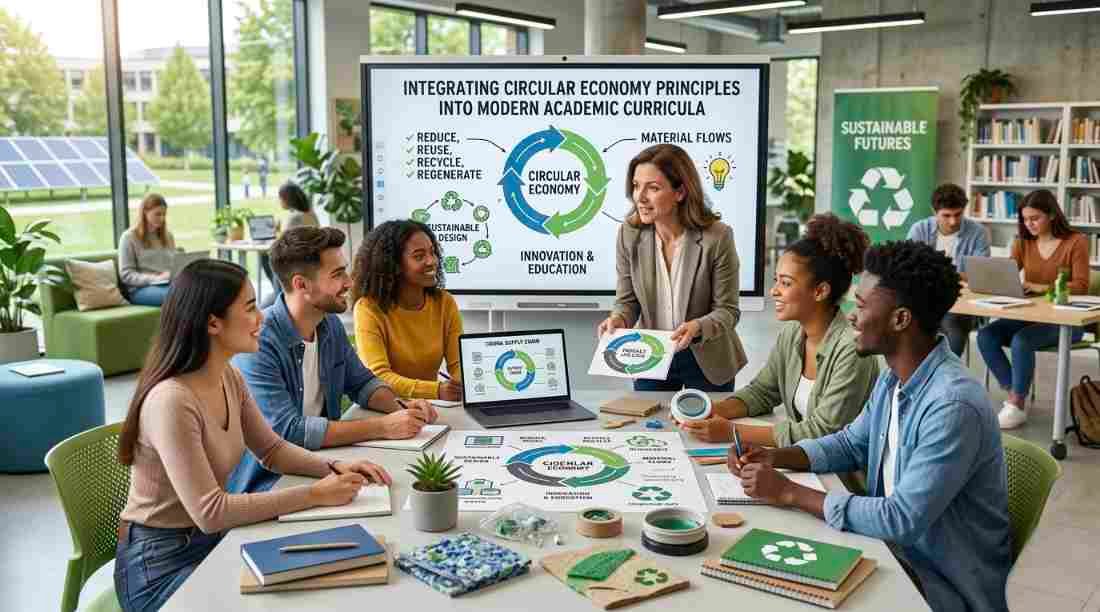
The environmental and economic costs of the linear model are undeniable. Resources are finite, and the environmental degradation caused by excessive waste and pollution is a major threat to global stability. The circular economy offers a compelling alternative. It is based on three key principles: designing out waste and pollution, keeping products and materials in use, and regenerating natural systems. It’s a model that benefits both business and the environment, creating a closed-loop system where nothing is wasted.
The Role of Education in a Circular Future
Achieving a circular economy will require a massive transformation in how we design, produce, and consume. This is not just a job for scientists and policymakers. It requires a fundamental shift in mindset, a new way of thinking that values resources, longevity, and regeneration. And this is where education plays a critical role. Our current education systems are, for the most part, built on the principles of the linear economy. We teach our students to consume, to use, and to replace. To move to a circular economy, we need to teach our students to design, to restore, and to reuse.
Integrating Circularity into the Science and Engineering Curricula
The technical aspects of the circular economy are most often associated with fields like engineering and environmental science. Integrating circular principles into these subjects is crucial, but it requires going beyond standard practices. In engineering, for example, students should not just learn how to make products more durable, but how to design them for easy disassembly and repair. In materials science, the focus must shift from new material synthesis to the development of bio-based, recyclable materials. Students need to understand the entire life cycle of a product, from raw material extraction to end-of-life disposal, and learn how to reduce environmental impact at every stage.
Circularity Beyond the Sciences: Business and Economics
One of the most powerful aspects of the circular economy is its potential for economic growth. By rethinking business models, companies can create more resilient supply chains, reduce material costs, and build deeper relationships with their customers. However, these new business models—from product-as-a-service to reverse logistics—are often counterintuitive to students trained in conventional business practices. Therefore, business and economics curricula must evolve to include these new paradigms. Students should be taught to recognize the long-term value of sustainable practices and to develop innovative strategies that create both financial and social value.
The Social Sciences and the Circular Transition
A transition to a circular economy is as much a social process as a technical or economic one. It requires changes in consumer behavior, political will, and social values. For this reason, the social sciences—sociology, political science, psychology—play a vital role in circular education. A student studying psychology, for example, could explore the factors that influence consumer decisions to buy durable goods versus single-use products. They could investigate how to design effective public awareness campaigns that promote recycling and reuse. To delve deeper into these behavioral patterns, students can benefit from tailored psychology assignment help, which provides specialized academic guidance to explore how these principles are applied in practical contexts. This helps to deepen their understanding of how psychological theories can be used to foster a more sustainable culture.
The Challenges of Integration: Overcoming Academic Silos
Integrating circular economy principles into academic curricula is not without its challenges. One of the biggest obstacles is the traditional siloed structure of academia. The circular economy is inherently interdisciplinary, requiring knowledge from fields as diverse as material science, design, economics, and law. A successful curriculum must break down these academic barriers, fostering collaboration and cross-pollination of ideas. This requires a rethink of how we structure our educational programs and how we assess student performance. The move towards a more holistic, system-thinking-based approach is often demanding for students, who might find themselves navigating unfamiliar academic terrain. During this process, seeking online assignment help can provide valuable support, helping students to synthesize complex ideas from multiple disciplines and to develop a comprehensive understanding of circular systems.
Case Studies in Academic Curricula
Several universities worldwide have already begun to pave the way for a more integrated approach to circular education. These programs often feature strong collaborations with industry partners, providing students with real-world experience and opportunities to apply their knowledge. From dedicated Master’s programs in Circular Economy to the integration of circular principles into existing undergraduate degrees, these institutions are demonstrating that it is possible to create innovative educational models that prepare students for the challenges of the 21st century.
Conclusion
Integrating circular economy principles into modern academic curricula is an essential step towards building a sustainable and resilient future. It requires a fundamental shift in our education systems, one that emphasizes systems thinking, collaboration, and a holistic view of resources. By providing our students with the skills and knowledge they need to design, build, and maintain circular systems, we can create a world where nothing is wasted, and everyone can thrive. This is not just an opportunity for educational reform; it’s a necessity for our planet.