

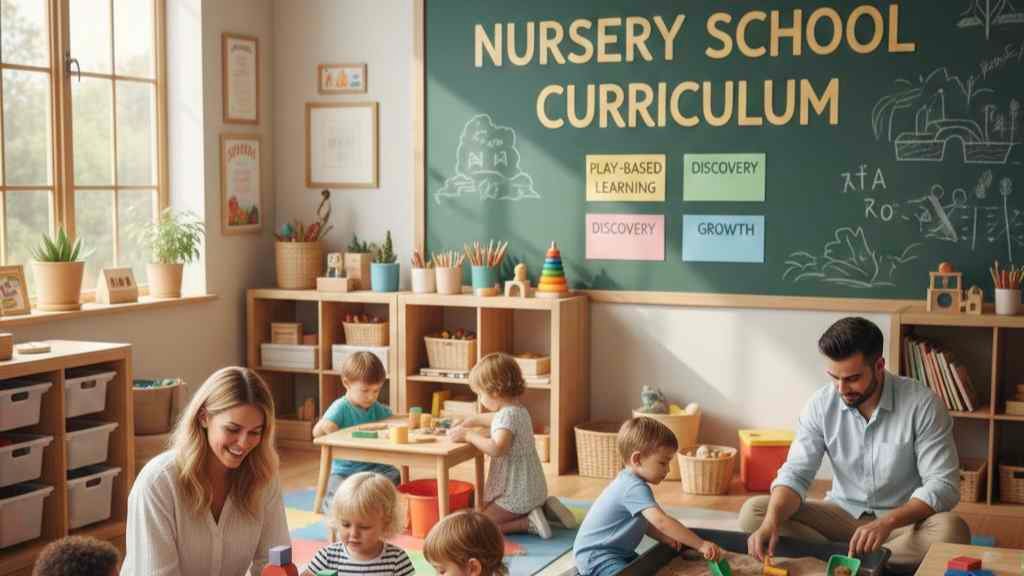
You want a safe, stimulating place where your child starts building social skills, early literacy, and curiosity—and nursery school does exactly that. Choosing the right program gives your child a strong foundation for learning and the confidence to explore new things.
This article breaks down what nursery school actually is, how it supports development, and practical steps to help you pick a program that fits your child’s needs and your schedule. Expect clear criteria for quality, questions to ask during visits, and realistic trade-offs so you can decide with confidence.
What Is Nursery School?
Nursery school provides early learning and supervised social time for children before they enter formal primary education. Expect structured play, basic routines, social skills practice, and introductory language, motor, and problem-solving activities.
Definition and Purpose
A nursery schools is an early childhood program that focuses on developmental readiness rather than formal academics. You’ll find a mix of free play, teacher-led activities, circle time, and simple routines designed to build attention span, language, and self-help skills.
The primary purpose is to prepare children for kindergarten by fostering social-emotional skills, early literacy and numeracy awareness, and physical coordination. Staff use age-appropriate materials—blocks, books, art supplies, and gross-motor equipment—to target specific developmental milestones.
You should expect individualized observation and small-group activities to support each child’s pace. Programs often include parent communication, simple assessments, and transitions that mirror a primary school day.
Differences Between Nursery School and Preschool
Nursery school and preschool overlap but differ in emphasis and structure. Nursery schools typically serve younger children (often 2–4 years), emphasize care and socialization, and may offer shorter sessions. Preschools lean more toward school-readiness goals with systematic preacademic activities for older 3–5-year-olds.
Key distinctions:
- Age focus: Nursery school skews younger; preschool targets children closer to kindergarten age.
- Curriculum: Nursery school emphasizes play-based social development; preschool includes more structured literacy and math pre-skills.
- Session length: Nursery programs often offer half-day or flexible care; preschools commonly run full-day or extended morning schedules.
Consider staffing ratios and teacher qualifications. Preschools may require teachers with certified early childhood credentials; nursery settings may have more varied staffing. Choose based on your child’s temperament and readiness for routine versus exploratory play.
Typical Age Range
Nursery school generally enrolls children from about 2 to 4 years old. Programs may accept children as young as 18 months, but many start around 24 months when children can participate in group activities.
Age groupings within a nursery school often look like:
- Toddlers: 18–30 months — focus on basic routines and social introductions.
- Older toddlers/early preschoolers: 30–48 months — increased group activities and language development.
You should verify the specific age cutoffs at local programs; some call themselves nursery schools yet serve up to age 5, overlapping with preschool. Check class size and teacher-to-child ratios to ensure appropriate supervision and individualized attention for the age range.
Core Principles of Early Childhood Education
Nursery schools apply core principles that support healthy development: play-based learning, responsive caregiving, routine and structure, and observation-informed planning. These principles prioritize active exploration, social interaction, and emotional regulation over drill-based instruction.
Practical applications you’ll see:
- Play-based learning: children learn concepts through blocks, dramatic play, and sensory activities.
- Responsive caregiving: teachers follow children’s interests and respond to cues to support attachment and self-regulation.
- Routine and transitions: consistent schedules (snack, play, nap) build predictability and independence.
- Assessment and adaptation: informal observations guide small-group planning and individualized supports.
These principles aim to strengthen language development, fine and gross motor skills, and social competencies that form the foundation for later academic learning.
Choosing the Right Nursery School
You should prioritize practical, observable details: staff qualifications and ratios, daily routines, learning goals, health protocols, and how the school communicates with families. Look for clear evidence of safe facilities, age-appropriate activities, and consistent caregiver-child interactions.
Key Factors to Consider
Ask about teacher-to-child ratios and confirm those numbers match licensing standards. Lower ratios (for example, 1:3 for infants, 1:6 for toddlers, 1:8 for preschoolers) mean more individual attention. Verify staff qualifications: lead teachers should have early childhood credentials or diplomas and ongoing professional development records.
Inspect the physical environment during a visit. Check for secure entrances, visible evacuation plans, clean toilets at child height, and age-appropriate furniture. Observe daily routines—consistent nap, snack, and outdoor play schedules support predictable behavior and sleep. Review policies on discipline, screen time, meals, and inclusion to ensure they match your expectations.
Curriculum and Educational Approaches
Identify whether the school follows a named curriculum (Reggio Emilia, Montessori, HighScope) or a bespoke play-based program. Ask for sample weekly lesson plans to see how literacy, numeracy, motor skills, and social-emotional learning are integrated. Look for clearly defined learning goals by age, not vague terms like “play-based” without structure.
Observe how teachers interact: do they scaffold language, extend a child’s idea, and document progress? Check assessment methods—portfolios, developmental checklists, and parent-teacher conferences are signs of organized tracking. Ensure daily free-play is balanced with teacher-led small-group activities that target specific skills.
Health and Safety Standards
Request written health policies and immunization requirements before enrollment. Confirm daily illness screening routines, exclusion criteria for contagious conditions, and procedures for medication administration. Ask how the school manages allergies and whether staff are trained in anaphylaxis response.
Inspect cleaning practices and toy sanitation schedules. Verify staff CPR and first-aid certification and ask how often drills (fire, lockdown) are practiced. Check outdoor play surfaces, gate locks, and furniture stability. Also confirm food sourcing and meal handling policies if the nursery provides snacks or lunches.